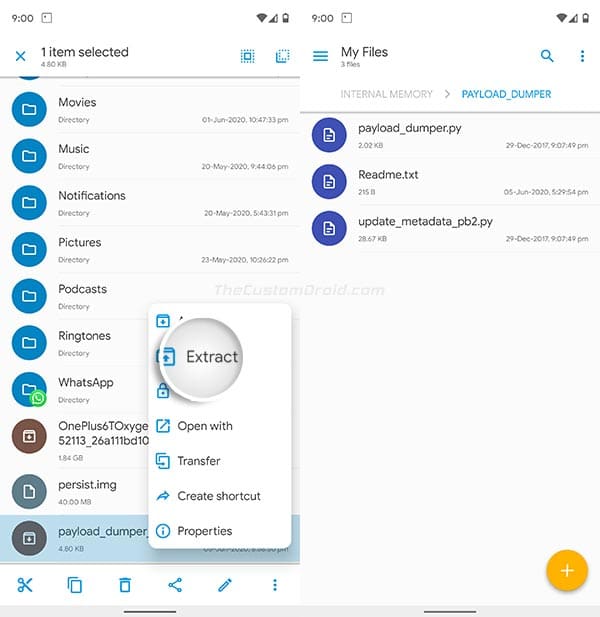
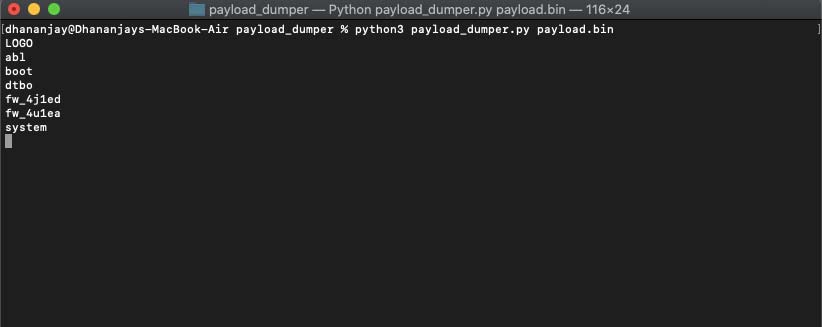
Here are 2 methods using which you can extract Android OTA Payload.bin. We recommend the PC guide but you can choose either according to your convenience. Extract Android OTA Payload.bin File on Android device. Download Payload Dumper Tool. Now extract the payloaddumpertoolbyius.zip file to the root directory of the internal storage of your. Extract payload.bin and get the stock boot image file. If you got a payload.bin file once you extract the downloaded firmware zip, just follow this guide. As prerequisites, you will be using Payload Dumper Tool and Python. Read More: How to Extract payload.bin and get the stock boot image file. Extract Boot.img Directly from Device without. 2) Extract the contents and identify the location of the backup extractor jar file. In my case it’s located here: “C: ADB android-backup-tookit android-backup-extractor android-backup-extractor-20180203-bin abe.jar” 3) Run the Java command to decrypt and extract the backup.
- Bin File Extractor For Android Apk
- Bin File Extractor For Android Phones
- Download Bin File Extractor For Android
- Bin File Extractor For Android Free

Introduction
Proprietary blobs can be extracted either from a device already running LineageOS or from a LineageOS installable zip. In this guide we will describe the steps required to extract proprietary files from installable zips.
Before beginning, it is required to know the difference between the types of OTAs:

- Block-based OTA: the content of the system partition is stored inside of an
.dat/.dat.brfile as binary data. - File-based OTA: the content of the system partition is available inside a folder of the zip named
system. - Payload-based OTA: the content of the system partition is stored as an
.imgfile inside ofpayload.bin.
If your zip has no system folder or it is nearly empty and a file named system.transfer.list exists at the root level, then what you have is a block-based OTA. Jump to Extracting proprietary blobs from block-based OTAs in this case.

If you have the entire content of the system partition inside the system folder and no system.transfer.list, then what you have is a file-based OTA. See Extracting proprietary blobs from file-based OTAs.
You may also have a payload-based OTA, which is what your device will use if it uses the A/B partitioning system. If that is what you have, jump to Extracting proprietary blobs from payload-based OTAs.
Extracting proprietary blobs from block-based OTAs
Some block-based OTAs are split into multiple files, for the system partition and the other partitions like vendor, product, oem, odm and others. You can verify if yours is split by looking for the corresponding *.transfer.list files for each in the root of the installable LinageOS zip.
If you have a split block-based OTA file then you will need to extract, decompress and convert each one in a similar manner to system and vendor as outlined below.
If you do not have a split OTA file, you may skip any step that references vendor.transfer.list and vendor.new.dat.br or vendor.new.dat
Create a temporary directory and move there:
Extract system.transfer.list and system.new.dat.br or system.new.dat from the installable LineageOS zip:
where path/to/ is the path to the installable zip.
If your OTA includes vendor.transfer.list and vendor.new.dat.br or vendor.new.dat (other others), extract them from the installable LineageOS zip as well:
where path/to/ is the path to the installable zip.
In the case of system.new.dat.br/vendor.new.dat.br/etc. (a brotli archive) exists, you will first need to decompress them using the brotli utility:
And if you have a vendor.dat.new.br (or others) file:
You now need to get a copy of sdat2img. This script can convert the content of block-based OTAs into dumps that can be mounted. sdat2img is available at the following git repository that you can clone with:
Once you have obtained sdat2img, use it to extract the system image:
And if you have a vendor.dat.new (or others) file:
You should now have a file named system.img that you can mount as follows:
If you also have a file named vendor.img, you can mount it as follows:
You must also now mount any other image files that you have in their respective directories.
After you have mounted the image(s), move to the root directory of the sources of your device and run extract-files.sh as follows:
This will tell extract-files.sh to get the files from the mounted system dump rather than from a connected device.
Once you’ve extracted all the proprietary files, unmount the vendor dump if you mounted it earlier:
Then unmount the system dump:
Finally, unmount any other images before deleting the no longer needed files:
Extracting proprietary blobs from file-based OTAs
Create a temporary directory to extract the content of the zip and move there:
Bin File Extractor For Android Apk
Extract the system folder from the zip:
where path/to/ is the path to the installable zip.
After you have extracted the system folder, move to the root directory of the sources of your device and run extract-files.sh as follows:
This will tell extract-files.sh to get the files from the extracted system dump rather than from a connected device.
Once you’ve extracted all the proprietary files, you can delete the files that were extracted from the zip:
Extracting proprietary blobs from payload-based OTAs
Create a temporary directory to extract the content of the zip and move there:
Extract the payload.bin file from the LineageOS installation zip file:
where /path/to/ is the path to the installable zip.
You will now need to use a tool called update-payload-extractor.
To use the tool, you will need python-protobuf, if you do not already have it:
You can now extract the .img files from the payload:
- If you have a LineageOS build tree checked out already, you can just run the script to extract the payload:
- If you don’t have a LineageOS build tree checked out, you can clone our scripts repo, and then run the script to extract the payload:
It will take a few moments. Once it’s done, we will need to mount the system.img file, and the vendor.img and product.img files if they exist, to obtain the complete set of proprietary blobs:
Move to the root directory of the sources of your device and run extract-files.sh as follows:
This will tell extract-files.sh to extract the proprietary blobs from the mounted system dump rather than a connected device.
Once it is done, unmount the system dump and remove the now unnecessary files:
Content of this page is based on informations from LineageOS Wiki, under CC BY-SA 3.0 licence.
There are situations when users need to open a “.bin” file on an Android smartphone. Initially, the smartphone system does not allow opening these files for viewing, since this is a set of executable commands for a computer. In this article, we will consider how you can view such a file on Android or from a computer.
Hide content
1 What is BIN format?
2 How do I open a .bin file on my phone?
2.1 Second way
3 Programs for viewing and editing BIN files
What is BIN format?
A bin file with the extension “.bin” at the end is a set of lines in binary format that consists of one or more commands. The content of the file is encoded into the usual text, but initially it is in binary format and consists of zeros and ones (0 and 1).
Please note that it can be dangerous to run these files, especially on computers. If you downloaded something from the Internet – the executable file may contain threats and viruses.
If you run such a file in Windows, the computer will execute in turn all the commands written inside. Usually it contains activation keys for programs, games, various “Cracks” and “Pills” for applications.
Therefore, if you are going to run such a file, you need to understand what it is in general and for what and from where you downloaded it.
How do I open a .bin file on my phone?
To see the contents of the file, you can try to open it in text format in a notepad on a PC or Android. If you only have a smartphone at hand. You will need to go to the file manager (you can use the built-in one in your smartphone):
- If you downloaded from the Internet, the file most likely lies in the “Downloads” or “Downloads” folder.
- Find the file in the smartphone’s memory and click “More” or the icon with three dots “…”.
- Then select “Open As” or “Open With” or “Open As Text” from the list. The item names may differ depending on your smartphone model.
- It will most likely NOT work to run this file directly on your smartphone. it will intend for the computer. But it is quite possible to view its contents.
Life hack: if you can’t open it through the file manager, you can rename the file. Change the extension “filename.bin” to “filename.txt”. We will get a text file that can be opened in any text editor and see its contents. Then change the extension .txt back to .bin.
Second way
If you can’t open BIN on a smartphone or it turns out to be problematic, you can use a computer. To do this, just transfer the file via USB cable to your PC. Can be copied to any disc or smartphone. Do not double-click the file! First, view its contents:
- Right click on the file.
- Hover over the “Open with” menu item.
- In the drop-down window, select the “Notepad” option.
Bin File Extractor For Android Phones
Opening a BIN file on a computer
If you wanted to download game files or a disc image, you need a specialized program. There are no such programs for Android, but for a desktop PC, you can choose one from the list below:
- Alcohol 120%;
- Ultra ISO;
- Daemon Tools;
Programs for viewing and editing BIN files
Download Bin File Extractor For Android
If there is an urgent need to see the content from your smartphone, you can install a free program for viewing and editing BIN content. On Google Play, just type “Bin editor” in the search box, then download and install any program. You can use the universal ISO Converter Extractor or the dedicated BIN Opener utility.
For most programs, you will need to enable USB debugging in the smartphone settings according to the documentation.